 Impact of Giving
 Wellstar Grand Gala
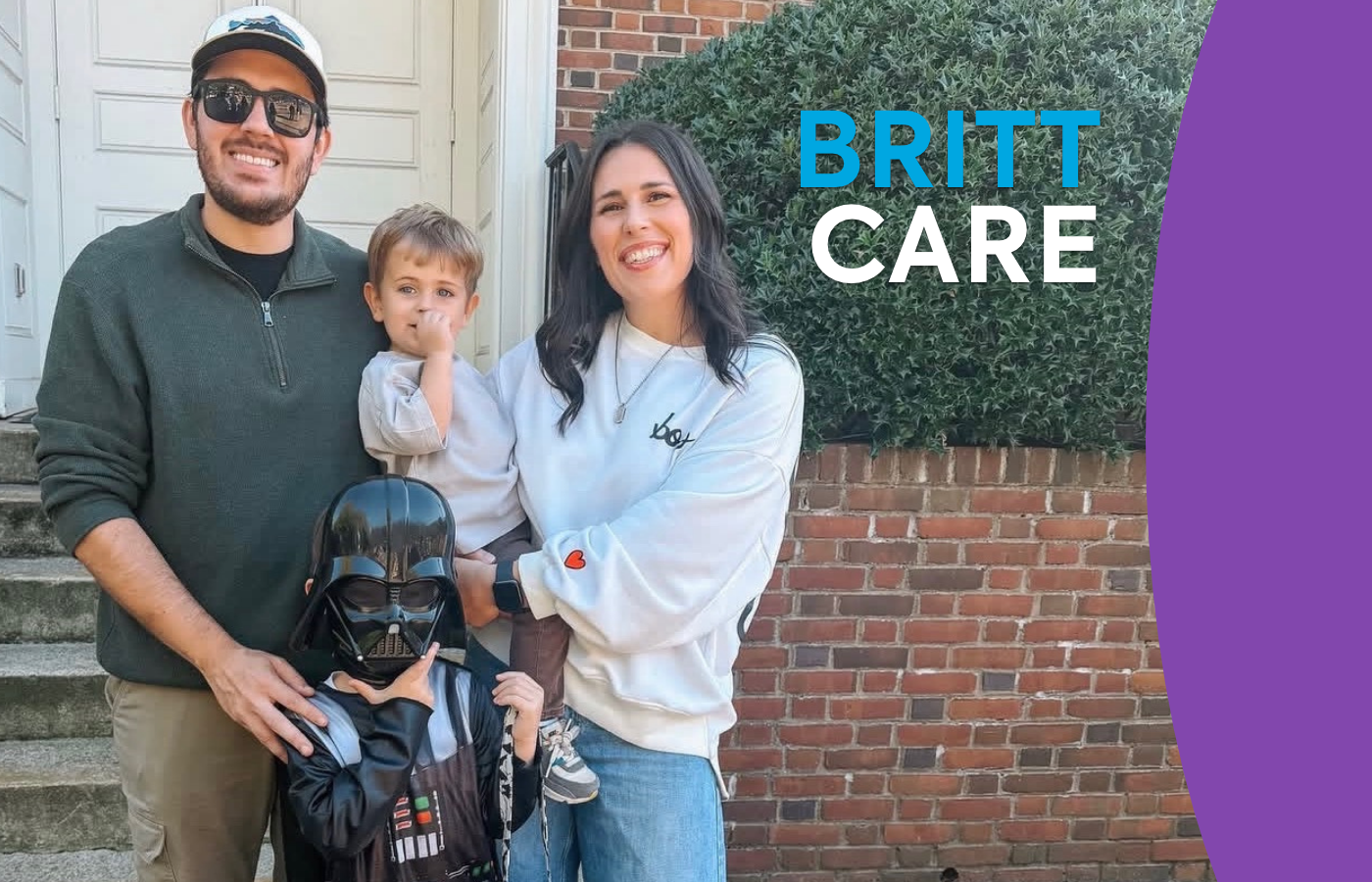
Working full time, maintaining her active lifestyle, and raising two boys — aged 5 and 2 — nothing could slow Brittany Barrett down. Until her world came to a crashing halt one February day when she was diagnosed with a brain tumor.
Unanswered questions
Years before her diagnosis, Britt started noticing things that didn’t add up. While pregnant with her youngest son, she began feeling off-balance, with occasional twitching and tingling on the right side of her face. She mentioned it to her OB/GYN at the time, who initially chalked it up to pregnancy hormones.
Eventually, her vision started to change. Then one day, she was flossing her teeth when she realized she couldn’t feel it — her face had gone completely numb. That’s when Britt knew something was seriously wrong.
Although Britt feared the worst, her OB/GYN suggested that she give birth and then wait at least six months for her hormones to balance before addressing anything further. Trusting her doctor’s word over her own instincts, Britt agreed to wait.
Searching for answers
When six months passed after Britt gave birth and she was still experiencing symptoms, she started reaching out to neurologists around Atlanta. Despite her symptoms and concerns, none of them would see her simply because she didn’t have headaches.
Frustrated and running out of options, Britt made an appointment at Cobb Internal Medicine Associates. She explained all of her symptoms and her medical history to Nurse Practitioner Abby Starstrom, MSN, RN, FNP-C. Abby immediately recognized that none of it was normal and ordered a CT scan.
“I thought, thank God someone is finally listening to me,” Britt recalled.
From scan to diagnosis
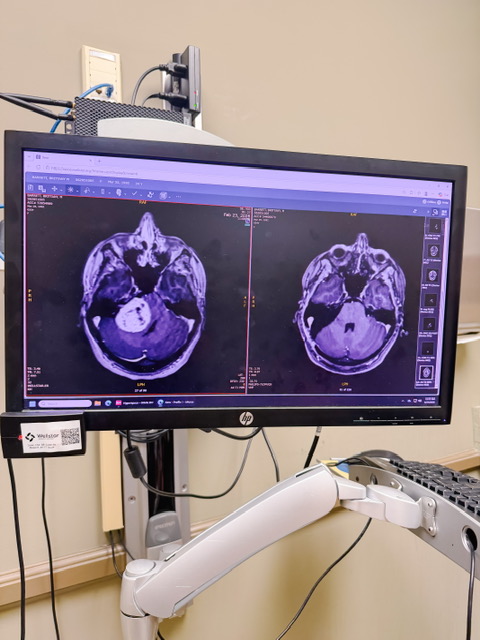
After three years of waiting for answers, Britt went in for her CT scan at 1 pm on February 23. At 8 pm that same night, the office called with urgent news: Britt’s scan revealed a 4.7 cm tumor — about the size of a lime — pushing on her circulatory system.
“They told me, ‘You have to go to the ER right now.’ I was in fight-or-flight; I had no emotions. I didn’t cry. I just looked at my husband,” Britt said. Her kids were with her in-laws at the time, so she just told her husband to get her to the hospital, without explaining why until they were in the car. He drove her straight to Wellstar Kennestone Regional Medical Center’s emergency room.
There, the team ordered an MRI. Due to the size of the tumor, Britt had to stay overnight.
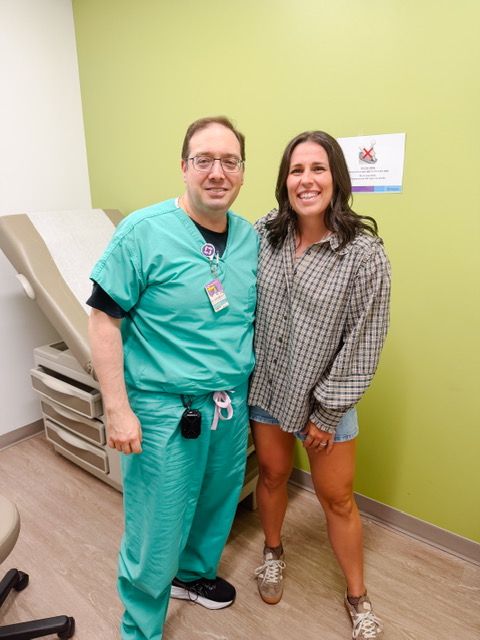
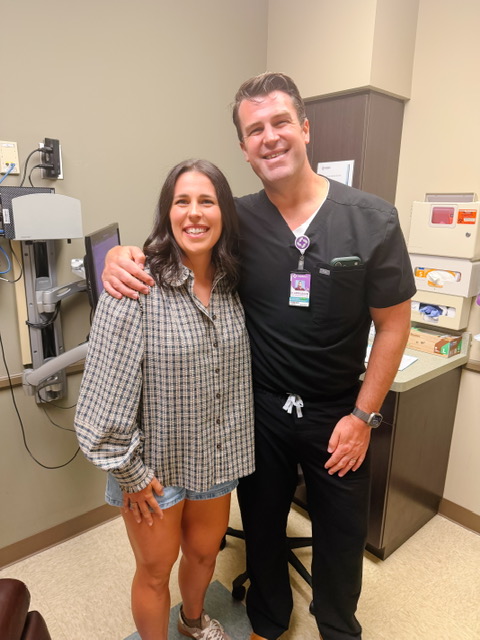
Neurosurgeons are typically booked out for months. But given the severity of her case, Britt skipped the line entirely. By February 25, she was meeting with Dr. William Benedict, head of neurosurgery, and Dr. Eric Appelbaum, neurotologist.
They told her that her tumor was a vestibular schwannoma — noncancerous — located at the base of her skull, extending into her ear canal and pressing on her brainstem, cerebellum and pons. She would need surgery to remove it.
“That was literally the worst day of my life. That was very hard,” Britt recalled.
Calm reassurance
Leading up to her surgery, Britt had endless fears and anxieties. She’d been disregarded by doctors for years. How was she supposed to blindly trust people she’d just met to perform brain surgery on her?
But from the moment she met Dr. Appelbaum and Dr. Benedict, they established a sense of calm and trust in Britt, despite having to deliver the worst news she had ever gotten.
“In the first five minutes, Dr. Appelbaum was telling me, ‘I need you to prepare. You’re going to lose your hearing. This is what’s going to happen. This is what it’s going to look like.’”
But he immediately followed the hard news with reassurance, citing a similar case: “Let me tell you about a patient that I did this exact same surgery on a week ago. And she’s in amazing hands. She’s doing incredible. She’s had such a good outcome.”
Dr. Benedict did the same. His initial meeting with Britt, her husband and her mom — scheduled for just 15 minutes — ran over an hour. He stayed with them, answering every question they had and walking Britt through what recovery would look like. When she broke down, his response of, “Britt, we’re going to bring you back. You’re going to be just fine… I would be terrible at my job if I didn’t bring you back,” was so calm and reassuring that it finally clicked for Britt. She could — and would — trust this team with her life.
It wasn’t until after her surgery that Britt learned just how much that trust had mattered. Dr. Benedict later told her that, had her tumor gone undetected, she likely had only four to six months left before it would have killed her or led to a medical emergency requiring urgent decompression surgery just to survive.
Waiting for the unknown
Britt’s surgery was scheduled just 15 days after her scan, so Britt and her family didn’t have much time to wrap their heads around what was to come.
“I wasn’t thinking about what the outcome was going to be for me. I was just like, if something happens, what’s my family going to do? So, I start going into preparation mode: are there wills in order? Do you have all the access to our bank accounts? Do you know how to get into the 401ks?”
But while Britt spiraled toward worst-case scenarios, her husband stayed steady, reassuring her she’d be fine and picking up the pieces when she fell apart.
“He stepped up in a huge way. When something like this happens, you learn, wow, I married the right person.” Britt said.
The day before her surgery, Britt and her husband tried to make it feel as fun as possible. They blew up a bounce house in her bedroom, her husband throwing the boys in and out of it as they spent the day surrounded by loved ones. But as night fell, the mood shifted.
“I basically had to tell [my kids] goodbye and tell them that mommy was going to be all better and that I would see them in a week — and it was like lying to them, because you don’t know if that’s actually the case,” Britt recalled emotionally.
The road to recovery
Dr. Appelbaum and Dr. Benedict performed an 11-hour craniotomy, successfully removing Britt’s tumor. Due to the tumor’s placement, Britt’s cochlear nerve was severed, resulting in permanent hearing loss in her right ear. Her facial nerve, however, was saved — a testament to her surgeons’ precision. Though she did experience temporary facial paralysis immediately after surgery, it resolved, and within a few months, Britt regained full movement and expression in her face.
“I could have landed anywhere, but I landed in the Kennestone ER with these two [Dr. Appelbaum and Dr. Benedict]. I truly believe I was in the best possible hands, with one of the most exceptional surgical teams anywhere,” Britt said.
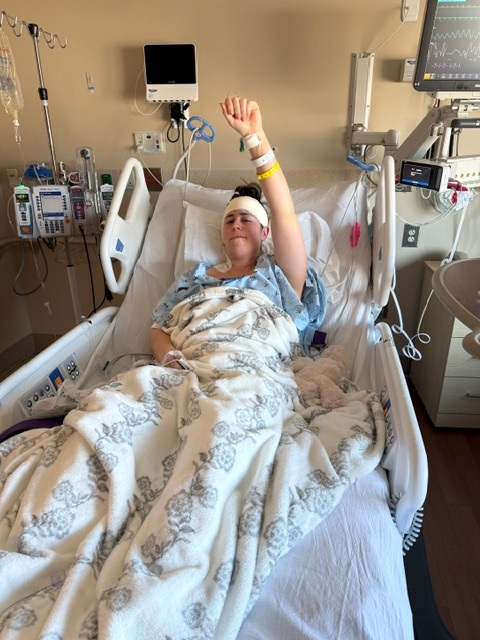
In the days that followed her surgery, Britt was in a lot of pain but pushed herself to start physical therapy anyway.
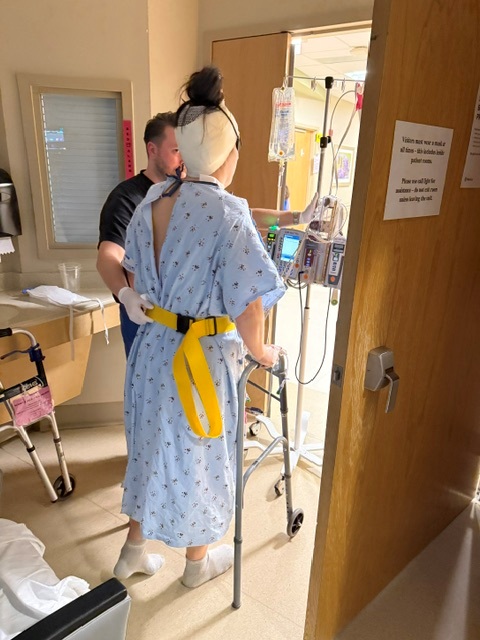
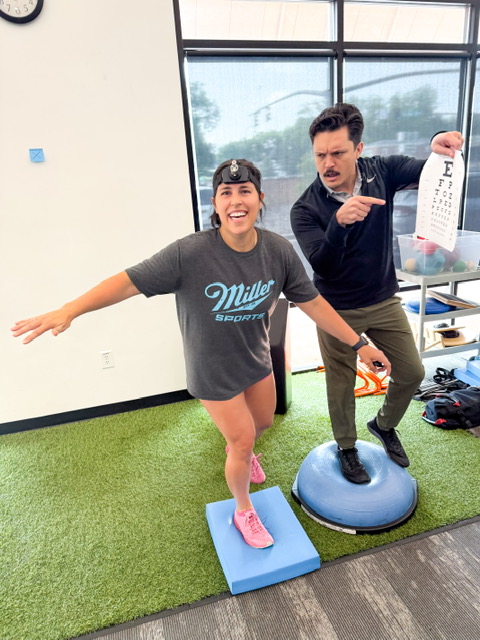
Britt spent five days in the hospital recovering, using a walker to get around. Ten days post-op, she started outpatient physical therapy (PT) at PT Solutions of Jonquil. By two weeks post-op, Britt was doing kettlebell swings in PT — proving that she could still do anything she put her mind to.
From patient to advocate
Britt had her three-month MRI in June, and the outcome was the best possible: her tumor is completely gone. Her next checkup is in December, and then she’ll need annual scans for the next 10-15 years, but her doctors are confident that her tumor is gone for good.
Though it was the most terrifying experience of her life, the lesson behind it wasn’t lost on Britt.
“I’ve always been someone who chased the next goal, worked my way up the corporate ladder and took a lot of pride in what I’ve accomplished professionally and personally. Then this happened, and it gave me a completely different perspective. I realized that while those accomplishments are meaningful, they aren’t what matters most. I’ve been given a second chance, and I want to be more intentional about how I spend my time, what I prioritize and the life I’m building with my family,” she said.
About a month after her surgery, Britt participated in the National Brain Tumor Society’s Georgia Brain Tumor Walk & Race in Atlanta to raise money for patients facing what she had just been through. But for Britt, that was just the beginning.
Throughout her own medical journey, Britt experienced the stress of being denied insurance coverage and having to pay out of pocket for care that she desperately needed. She is now working to establish a fundraiser to help others in the same position.
“I truly believe maybe this was the purpose for it all — why I was chosen — because I wasn’t just going to get through it. I was going to go do something with it afterward that maybe people wouldn’t usually do.”

A future worth fighting for
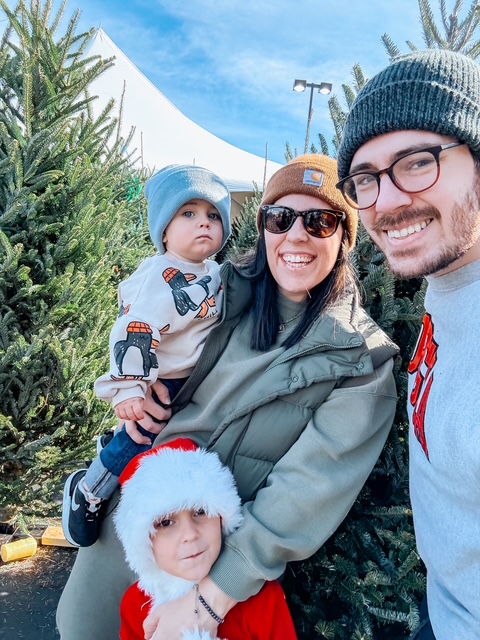
Today, Britt is back to feeling like herself again. She’s back in the gym, doing CrossFit, chasing her boys around and enjoying life. Sometimes, all at once.
“My sons love coming to CrossFit with me. We actually do little workouts. It’s really fun. We try to include them in a lot of fitness because it’s such a big part of my life,” said Britt.
As a family, they’re planning a trip to Disney this fall, ready to put this chapter behind them and start making new memories.
On a personal level, Britt has her sights set on a new challenge: going out west and spending all day hiking to the top of a mountain.
“I was told before surgery that I would probably have to learn to walk again. I got told crazy things. I had to do three months of physical therapy. And so, I put in all this work — and things could have looked different, but here I am. Even though this did affect me, I can still be the same person I was before the surgery,” said Britt.
The experience left its mark on her oldest son, too. He now performs his own version of brain surgery — on his stuffed animals, removing their “tumors” so they can “be just like mommy.” When Britt asked him what he wanted to be when he grew up, his answer was immediate: a tumor doctor.